You’ve outgrown DIY GoHighLevel the moment your agency spends more time babysitting the tool than billing for it — when reports get rebuilt by hand every month, when ad data never lands in the CRM, when “just add another Zap” has become a monthly ritual, and when a client asks “where did this lead come from?” and you genuinely can’t answer. Those are the symptoms of a no-code stack that hit its ceiling, and for a New York City agency competing against thousands of others, that ceiling is expensive. The fix isn’t more clicks inside the GoHighLevel builder — it’s custom GoHighLevel development: purpose-built API integrations, client reporting portals, clean CRM migrations, and custom AI agents that do exactly what your workflow needs. This post lays out the seven signs, with the data behind each one, and what a developer actually builds to clear them.
I spent eight years running fulfillment for a 40-client SEO and PPC shop before going independent, and the pattern was always the same: GoHighLevel out of the box is brilliant right up until you scale past it. Then the workarounds you were proud of start costing you the margin you built them to protect. Here’s how to tell you’ve crossed that line — and what to do about it.
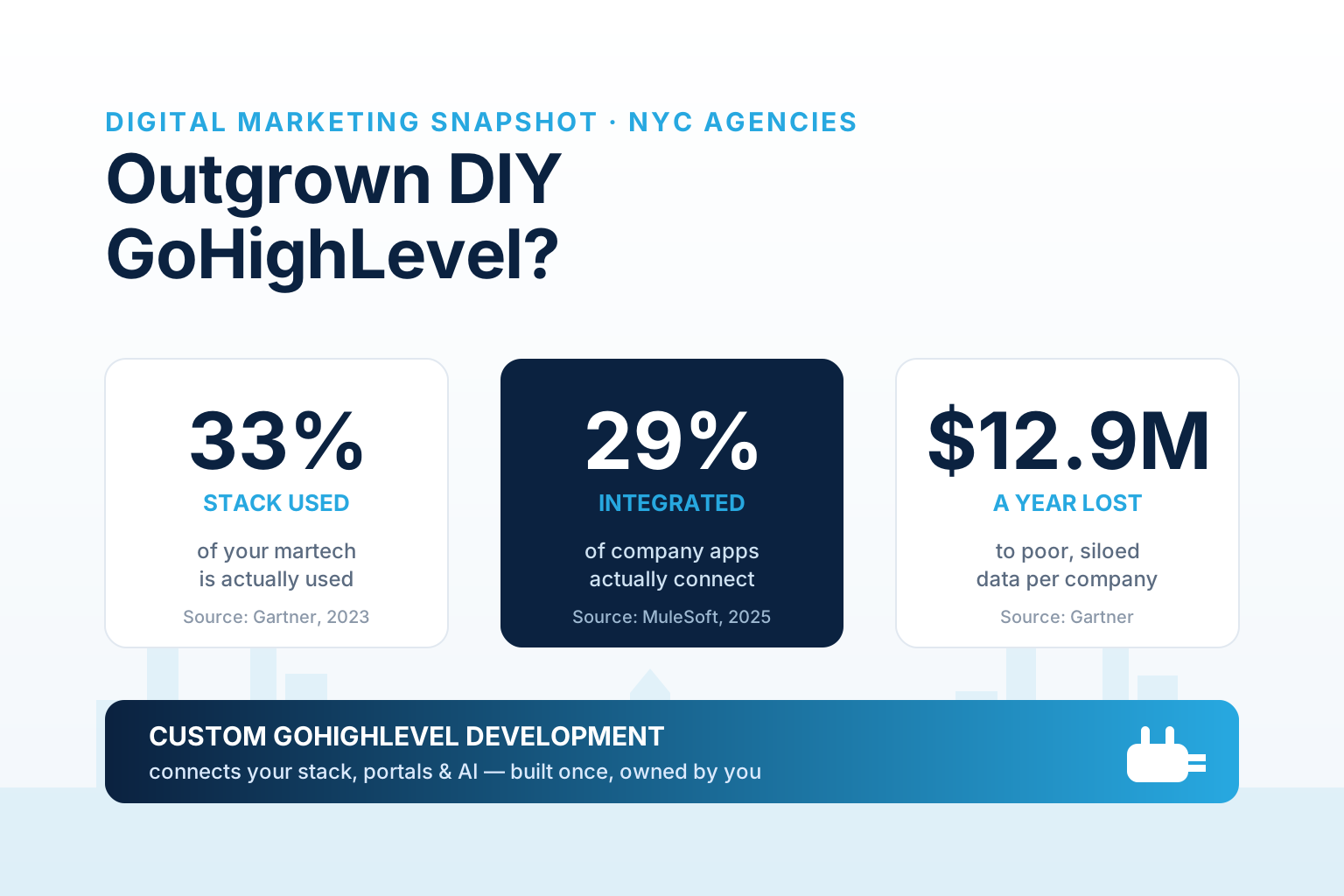
Table of contents
- What “DIY GoHighLevel” means — and where it stops scaling
- The hidden cost of a duct-taped agency stack
- The 7 signs you’ve outgrown DIY GoHighLevel
- What custom GoHighLevel development actually fixes
- DIY GoHighLevel vs custom development
- The ROI: why building it right pays for itself
- Why this matters more for NYC agencies
- FAQ
What “DIY GoHighLevel” means — and where it stops scaling
“DIY GoHighLevel” is the version almost every agency starts with: the no-code builder, the drag-and-drop workflows, a snapshot you imported, and a growing pile of Zapier or Make automations bridging the gaps GHL doesn’t cover natively. It’s a genuinely powerful starting point — you can run a lean agency on it for a long time, and you should. The GoHighLevel snapshot model exists precisely because most of what an agency needs can be pre-built and cloned.
The ceiling appears when your requirements get specific. A client wants a live login to see their own numbers. Your ad platforms need to write conversions back onto GHL contact records. You’re migrating a 20,000-contact account off HubSpot without losing history. You want an AI agent that actually understands your med-spa clients’ intake process, not a generic FAQ bot. None of that is a “click three more boxes” problem — it’s a build problem. And when you try to force it through no-code duct tape, the workarounds become fragile, undocumented, and dependent on you personally to keep alive.
That’s the line. DIY is right until the workaround costs more — in hours, in errors, in risk — than the thing it’s working around. Past that line, you don’t need more automations; you need custom GoHighLevel development.
The hidden cost of a duct-taped agency stack
Before the seven signs, look at the macro picture, because it explains why this happens to almost everyone. The core problem isn’t that agencies lack tools — it’s that the tools don’t work together.
Start with utilization. Gartner’s marketing-technology survey found that marketers report using just 33% of their martech stack’s full capabilities in 2023 — the second straight annual decline, down from 42% in 2022 and 58% in 2020 (Gartner, via MarTech). You’re paying for tools you barely touch, and the reason is almost always the same: they’re too disconnected to be worth the effort.
Percent of martech stack capabilities marketers actually use, by year — a steady decline. Source: Gartner Marketing Technology Survey, 2023.
The integration gap is the root cause. In Salesforce and MuleSoft’s 2025 Connectivity Benchmark, the average organization runs 897 applications but has only 29% of them integrated, and 90% of IT leaders say data silos are creating business challenges (MuleSoft, 2025). Data professionals agree: 68% named data silos their top concern in 2024, up seven points year over year (DATAVERSITY, 2024).
And disconnection has a price tag. Gartner estimates poor data quality costs the average organization $12.9 million per year (Gartner). For an agency, that shows up smaller but sharper: a lead double-counted, a report that contradicts the client’s own dashboard, an attribution gap that makes a winning campaign look like a loser. Every one of those chips at the trust that keeps a retainer signed — the same trust you protect with automated, accurate reporting.
The 7 signs you’ve outgrown DIY GoHighLevel
If three or more of these describe your agency, you’re past the ceiling.
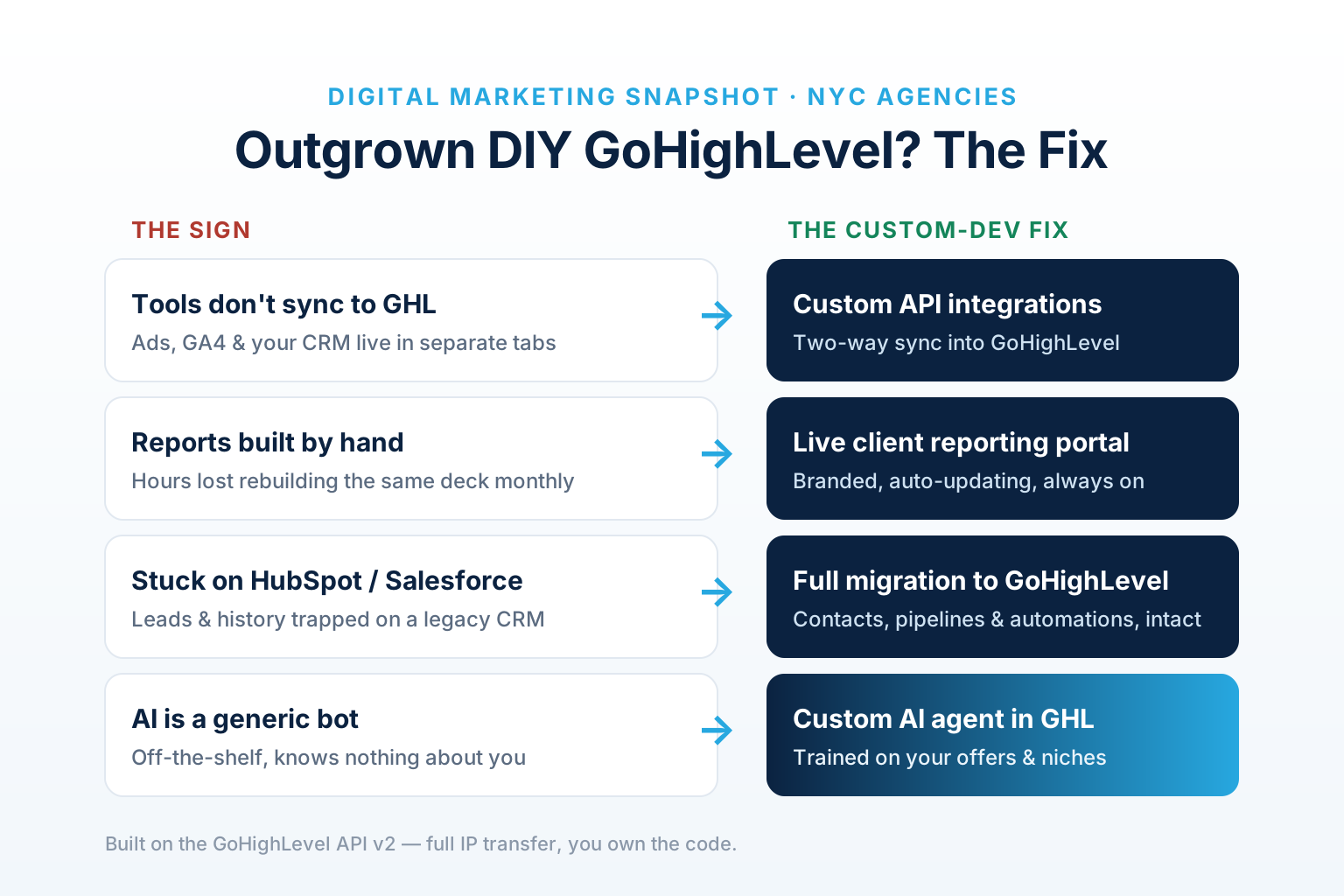
- Your tools don’t talk to GoHighLevel. Google Ads, Meta Ads Manager, GA4, your call tracker, and your reporting tool all live in separate tabs, and the data only reaches GHL when someone copy-pastes it. Attribution breaks the moment a client asks where a lead came from.
- You rebuild the same report by hand every month. The numbers live in five places, so proving your value means an afternoon of exports and spreadsheet surgery. Only about 10% of companies have fully automated their customer journey, leaving most teams stitching tools together manually (Ascend2).
- You can’t cleanly prove ROI. When the source data is siloed, cost-per-lead and ROAS become arguments instead of facts. Measuring ROI is the #1 marketer challenge, cited by 33% (HubSpot) — and it’s why lead attribution that actually proves ROI is a competitive advantage, not a nice-to-have.
- GoHighLevel is missing a feature you need. A client-facing reporting portal, a niche ROI calculator, a proposal builder, a specific approval workflow — GHL doesn’t ship it and no plugin quite fits. You need it built.
- You’re stuck on another platform. Your leads, pipelines, and history are trapped in HubSpot, Salesforce, Pipedrive, or ActiveCampaign, and moving to GHL feels too risky to attempt without help.
- Your “AI” is a generic bot. An off-the-shelf chatbot that knows nothing about your offers or your clients’ industries books the wrong calls and frustrates good leads — the opposite of the AI systems a modern agency runs.
- You are the bottleneck. The whole fragile system depends on you personally to keep it running, so you can’t take on more clients without adding headcount you don’t want.
What custom GoHighLevel development actually fixes
Custom development isn’t a rip-and-replace of GoHighLevel — it’s the layer that makes GHL do what your agency actually needs. Each sign above maps to a concrete build:
- Connect any platform to GHL. Two-way sync between GoHighLevel and Google Ads, Meta Ads, GA4, Search Console, CallRail, Stripe, or any tool with an API — so contacts, ad spend, conversions, and pipeline stages stay consistent and attribution stops breaking. This is the same principle as routing Facebook Lead Ads straight into GHL, extended across your whole stack.
- Build a client reporting portal. A branded portal that merges GHL pipeline value with ad-platform data into one live view each client logs into — leads, cost-per-lead, ROAS, call volume — which kills the monthly manual report for good. It’s the productized version of the white-label client portal.
- Migrate cleanly onto GoHighLevel. Contacts, custom fields, pipelines, automations, and history mapped field-by-field and rebuilt natively — the disciplined version of migrating an agency to GoHighLevel without data loss.
- Deploy custom AI agents. Chat, SMS, and voice agents trained on your offers and your clients’ niches that qualify leads, book into the GHL calendar, and tag by campaign automatically — not a scraped-web FAQ bot.
The appetite for this is already here: 63% of marketing leaders say they plan to invest in generative AI within two years (Gartner, 2023). The agencies that win will point that investment at custom, owned systems — not another disconnected subscription.
DIY GoHighLevel vs custom development
The honest comparison isn’t “no-code bad, code good” — it’s knowing which job each is for.
DIY GoHighLevel vs custom GoHighLevel development
| Plan | DIY / no-code GHL | Custom GHL developmentRecommended |
|---|---|---|
| Price | Fast to start, hard to scale | Built once, owned by you |
| Feature 1 | Great for standard workflows | Purpose-built for your workflow |
| Feature 2 | Breaks on custom requirements | Two-way API integrations |
| Feature 3 | Fragile Zap/Make chains | Live branded reporting portals |
| Feature 4 | Attribution gaps across tools | Clean migrations, no data loss |
| Feature 5 | No client-facing portal | Custom AI agents in GHL |
| Feature 6 | Depends on you to maintain | Full IP transfer — you own the code |
| Get a build scoped → |
Most agencies run both: no-code for the standard 80%, custom development for the specific 20% that actually differentiates them and is too important to leave fragile. The skill is recognizing when a workaround has quietly become mission-critical — because that’s the piece that should be built properly.
The ROI: why building it right pays for itself
The reason to build instead of duct-tape isn’t elegance — it’s return. Nucleus Research, reviewing 16 ROI case studies, found that marketing automation returns an average of $5.44 for every $1 spent over its first three years, with payback in under six months (Nucleus Research).
Average return on marketing automation: $5.44 for every $1 spent over three years, payback under six months. Source: Nucleus Research.
A custom build concentrates that return where it matters most for an agency. The reporting portal that saves your team ten hours of manual work a month pays for itself in the first quarter. The integration that fixes attribution lets you keep — and raise — a retainer you’d otherwise lose to “I can’t see the value.” And because full IP transfer is standard, the code lives in your repo and runs under your accounts: you’re buying an asset, not renting another seat.
Why this matters more for NYC agencies
New York is the deepest — and most crowded — agency market in the country. The city’s population reached roughly 8.48 million as of July 2024 (U.S. Census Bureau / NYC Dept. of City Planning), and New York consistently ranks among the top states for marketing-manager employment nationally (U.S. Bureau of Labor Statistics). That density cuts both ways: an enormous pool of businesses that hire agencies, and a wall of competitors one search result away.
In a market like that, operational polish is the differentiator prospects can feel. The NYC agency whose clients log into a live portal, whose attribution survives scrutiny, and whose systems don’t wobble when they add ten accounts looks like the safe, professional choice — because it is. A fragile DIY stack, by contrast, caps how many clients you can serve before quality slips, and in New York a slip gets noticed fast. Custom development is how a lean shop punches above its weight against bigger, better-funded competitors: you spend once to build the system, then run more clients through it without adding people.
If you’re mapping where custom development fits alongside the rest of your systems, our overview of AI for marketing agencies and the deep-dive on GoHighLevel vs HubSpot show how the pieces connect.
FAQ
Custom GoHighLevel development for NYC agencies — quick answers
How do I know I've outgrown DIY GoHighLevel?
The clearest tell is time: when you spend more hours maintaining workarounds than the workarounds save. Concrete signs include tools that don't sync to GHL, reports rebuilt by hand every month, attribution you can't defend to a client, a needed feature GHL doesn't have (like a client portal), being stuck on another CRM, a generic AI bot, and a system so fragile it depends on you personally to run. Three or more means it's time to build.
What is custom GoHighLevel development?
It's software built on the GoHighLevel API v2 that integrates with, extends, or automates GHL for your agency — custom API connectors between GHL and your ad platforms, branded client reporting portals, full CRM migrations onto GHL, and custom AI chat/SMS/voice agents. It's the layer that makes GoHighLevel do exactly what your workflow needs instead of forcing your workflow to fit the no-code builder.
Isn't it cheaper to just add another Zapier automation?
For simple, standard tasks, yes — and you should. No-code bridges are the right tool for the routine 80%. They become a false economy when a workaround turns mission-critical: fragile Zap chains break silently, have no error handling, and depend on one person's memory. Once a piece is important enough that its failure costs a client, it's cheaper over time to build it properly with monitoring and full ownership.
Will custom development lock me into a developer?
It shouldn't. Full IP transfer should be standard: the code lives in your repository, deploys to your infrastructure, and runs under your accounts. You own it outright, so you can maintain it yourself, hand it to another developer, or extend it later. You're buying an asset, not renting dependency.
Can I resell what you build to my clients?
That's often the best part. A branded client reporting portal, a custom AI agent, or a migration process can be productized into a retainer add-on or a paid onboarding you sell across your whole roster. The system you build to fix your own operations becomes a new margin line — the same move that turns automation into recurring revenue.
How long does a typical GHL build take for a NYC agency?
It depends on scope: a single platform connector is usually 1–3 weeks, a client reporting portal 4–8 weeks, a custom AI agent 3–4 weeks, and a full CRM migration to GoHighLevel 2–4 weeks. Every project is scoped with a fixed timeline, milestones, and a written price before work starts, so there are no surprises. Book a discovery call to get yours scoped.
Written by Marisa Quintero, Agency Operations Strategist. Marisa spent eight years running fulfillment for a 40-client SEO and PPC shop before going independent, and is obsessed with the boring half of agency life — onboarding, reporting cadences, and retainer renewals — because that’s where margin quietly leaks out. She writes about turning messy agency workflows into GoHighLevel systems that hold up at scale.
Related reading: What Is a GoHighLevel Snapshot? · Lead Attribution That Proves ROI · Migrate Your Agency to GoHighLevel · White-Label Client Portal Guide · GoHighLevel vs HubSpot for Agencies · Scale Without Adding Headcount